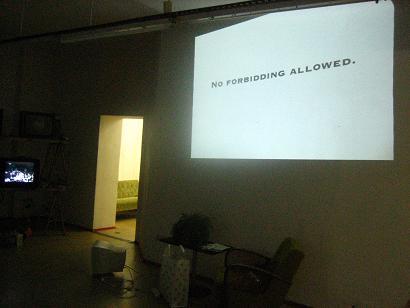
Videoinstallation
Am Mittwoch, den
21. September
wird in der Karl-Kunger-Straße 55, Alt-Treptow ab 20 Uhr eine
Video-Installation mit Filmen von Guy Debord,
Räuberhauptmann und Gründungsmitglied der
Situationistischen Internationalen, aufgebaut. Die Filme haben
Englische Untertitel und deswegen wir diese Beschreibung auch auf
Englisch fortgesetzt.
For the creation
of the video installation, we need televisions, DVD players, video
players, as well as head phones, but not the in-ear kind. If you
could help us with any of the mentioned items, please contact
joep@loesje.org.
Thanks!
In
the heritage of Guy
Debord, his movies assume a lasting impression. "Even though I
have read a lot, I have drunk even more. I have written much less
than most people who write; but I have drunk much more than most
people who drink." Indeed, he only finished short essays, and
one book, The society of the Spectacle. This book from 1967 could be
considered as the theoretical condensation of a „practice of
systematic questioning of all the works and diversions of a society,
a total critique of its notion of happiness.“
Debord as a mole
undermines and penetrates more and more of our thinking and acting in
our society. His heaps appear at (un)expected and (un)wanted places,
ruining perfectly nurtured lawns, disrupting idiosyncratic reigns of
order. Whether symbolism of the lawn represents theory or practice in
architecture, media, art, or the „good life“ in
general, his
thought cannot leave the good reader unchanged.
His ideas might
be more
accessible by watching the movies he has written and directed. That
is, if they were more known and accessible themselves. As far as I
know, this is the first time Debord’s (subtitled!) movies are
for
public (re)view in Berlin.
Some arbitrary
quotes from
some random movies:
What was directly
lived
reappears frozen in the distance, engraved in the tastes and
illusions of an era and carried off with it.
Stars are not
created by
their talent or lack of talent, or even by the film industry or
advertising. They are created by the need we have for them. A
pathetic need, arising out of a dismal and anonymous life that would
like to enlarge itself to the dimensions of cinematic life. The
imaginary life on the screen is the product of this real need. The
star is the projection of this need. The advertisements during
intermissions are the truest reflection of an intermission from life.
We could expect
nothing of
anything that we ourselves had not altered. The urban environment
proclaimed the orders and tastes of the ruling society just as
violently as the newspapers.
Like lost
children we live
our unfinished adventures, tending toward a role of pure consumption,
particularly the free consumption of our own time.
The only
interesting
venture is the liberation of everyday life, not only in a historical
perspective, but for us, right now. We are ready to blow up bridges,
but the bridges let us down.
Back to programme